
An AI agent needs more than a prompt to participate responsibly in business work. It needs relevant context, clear limits on the actions it can take and a way for people to review what happened. Fluency alone does not make an answer correct or an action appropriate.
A useful starting point is to describe a bounded task. Preparing a draft follow-up is different from sending a contractual commitment. Those tasks should not receive the same information, permissions or approval path.
Separate customer context from general knowledge
Customer context explains the relationship: the inquiry, previous conversations, current owner and next promised step. Business knowledge explains how your organization works: product information, procedures and approved guidance.
Both can help an assistant, but they have different maintenance and access needs. An outdated procedure can produce a well-written but wrong response. A current procedure applied to the wrong customer can also be wrong.
Make the permitted action explicit
An agent that drafts text is not the same as an agent that can update a record, send a message or trigger a workflow. List the tools it may use and the conditions under which each use is allowed.
For an illustrative follow-up workflow, you might permit reading a relevant inquiry and preparing a suggested response. Sending that response could require the assigned teammate's approval. This boundary should be understandable before the workflow is enabled.
- State which records and knowledge sources are relevant.
- Limit tool permissions to the task.
- Decide which outputs require human approval.
- Define how to stop, retry or escalate an unsuccessful action.
Plan for missing or conflicting information
A responsible workflow needs an exception path. If the customer's request is unclear or two sources disagree, the system should have a way to ask for clarification or return the task to a person.
Do not treat an apparently confident answer as evidence that the underlying information was sufficient. Test cases should include incomplete records, stale instructions and requests that fall outside the workflow's scope.
Keep a reviewable account of the work
People reviewing an AI-assisted task need to know what was requested, which relevant information was used, which action was proposed or taken and where human approval occurred. The level of detail should reflect the consequence of the task.
Review should also consider access and data handling. Before sharing production data with a model provider, confirm the applicable processing terms, retention and configuration. Avoid turning a general AI conversation into an uncontrolled copy of sensitive customer records.
Understand the role of an intelligence layer
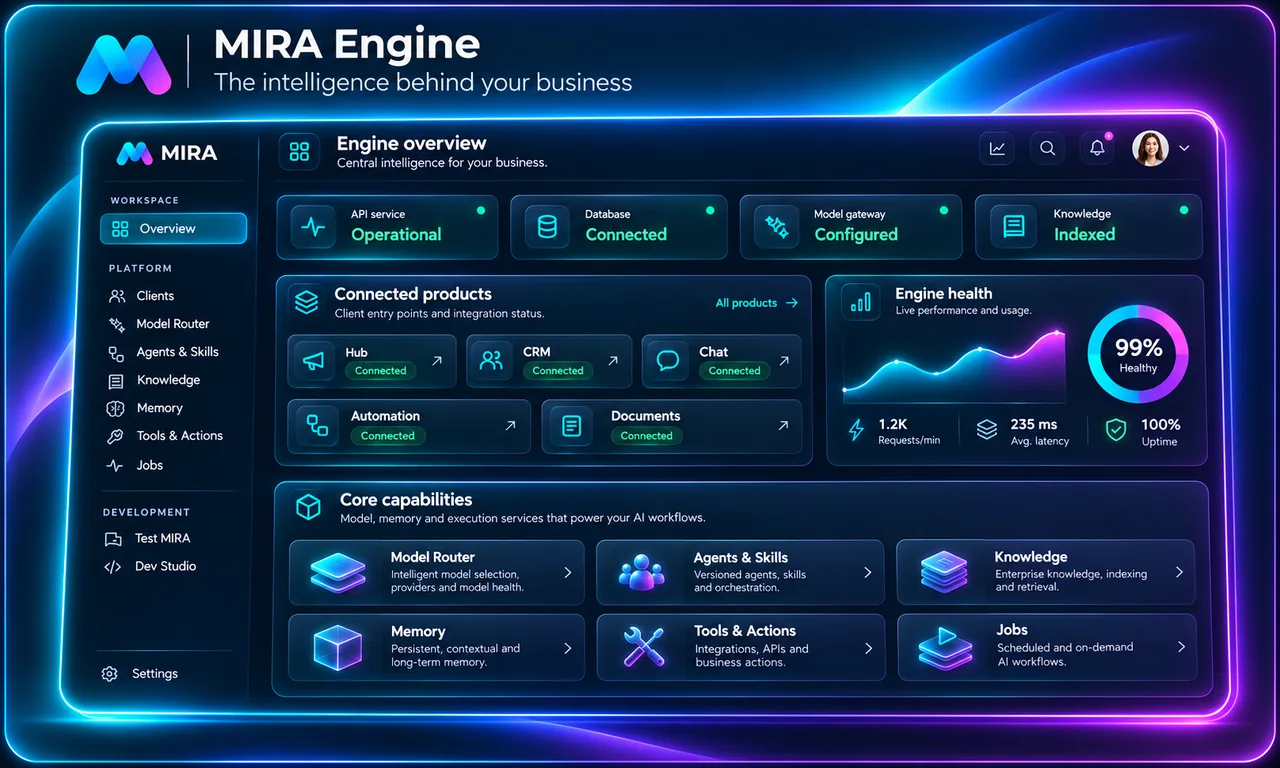
MIRA Engine is the AI infrastructure behind the planned MIRA workspace. Its role includes model routing, agents and skills, knowledge, memory, tools and coordinated actions. These concepts help explain how information and execution can be connected, but they do not by themselves guarantee accuracy or safety.
The public marketing website remains separate from that infrastructure. Submitting an early-access request does not send the form data to an AI model or an operational MIRA service.
Start with a task a person can review
Choose a task with a clear input, a recognizable useful output and a named reviewer. Agree what counts as an unacceptable result before the trial. Review real examples and refine the scope before granting more autonomy.
The test is not whether the agent sounds impressive. It is whether the team can understand, verify and appropriately control the work it is helping with.
Sources & further reading
Primary references for readers who want to explore the concepts further. Examples and evaluation checklists are MIRA editorial analysis.
Practical explanations from the team building MIRA. MIRA is in early access; product and integration availability must be confirmed during onboarding. Questions or corrections? Contact us.